Discover books that sharpen critical thinking, expand knowledge, challenge your ideas, and help you develop a deeper understanding of the world.
Looking for the best books to make you smarter? Whether you’re after fiction or non-fiction, the right books can boost your IQ and sharpen your thinking. Reading daily, from thrillers to psychology, really helps you think faster and smarter.
Books aren’t just for fun; they can help you figure out life better. When I started reading books like Make It Stick and Procrastination, I noticed my focus improved. It’s not magic, just smart science made simple.
Have you ever wondered how some people seem to make better decisions? Books on cognitive psychology and human history help you see why. For instance, A Brief History of Time gave me a new way to look at the universe and my place in it.
Some novels, even thrillers or romance, stretch your mind differently. They teach you to see things from other angles. I once read a story that changed how I judged a situation at work—it stuck with me.
And don’t worry if you prefer novels or poetry. Fiction is great for learning how to read between the lines and understand people better. I remember finishing a novel and suddenly catching a small but clever clue about human nature I’d missed before. Cool, right?
Some notable books that help boost intelligence include Make It Stick, Uncommon Sense Teaching, and Jared Diamond’s Guns, Germs, and Steel. These easy reads, packed with facts and ideas, make your brain work harder without feeling like school.
Reading more will make you smarter and wiser, plain and simple. It’s like training your brain—just a little each day—and you’re thinking clearly and faster before you know it. So, what are you waiting for? Pick up a book and get smarter today.
1. Cosmos by Carl Sagan
Carl Sagan's "Cosmos" tells the history of the cosmos for 15 billion years, which is incomparable to anything.
This book shows how extensive and profound Carl's interests are and draws readers to a fascinating world.
Although this book is mainly about how science develops in our society, it deals with topics such as history, philosophy, religion, and culture.
The book is simple and understandable to those without a scientific background.
Promising review:
What a privilege and joy it was to have read this book. I made my way through it rather slowly because it was so packed full of historical anecdotes, scientific findings, and thought-provoking insights that I needed a break every chapter or so to let ideas mentally sink in. In 13 chapters, Dr. Sagan gives us a glimpse into all scales of space and time.—Read More—Nichanan Kesonpat
Click Here To Check Out More of Author Carl Sagan's Books on Amazon.
2. This Will Make You Smarter by John Brockman
This Will Make You Smarter: This is the question John Brockman asked the most influential thinker in the world. Their visionary answers come from psychology, philosophy, economics, physics, sociology, and other fields.
Amazing and inspiring, these insights will radically change the way you see yourself and the world.
Promising review:
Brockman's books extracted from Edge.org are really hubs that, through their spokes (the essays they group together under one question), allow the reader to reach out and grab, experience, and explore the often difficult-to-follow contemporary thought in many scientific disciplines. Otherwise, we could define them as toolkits from which to extract the necessary tool that helps us to better understand our ever-changing world.—Read More—Magazine Sabina
Click Here To Check Out More of Author John Brockman's Books on Amazon.
3. Train Your Brain by Dr. Ryuta Kawashima
Train Your Brain: This essay promises to stimulate your brain to prevent its aging and loss of ability. It contains a series of spreadsheets that you exercise every day to improve your brainpower. Japanese bestseller is a practical and fascinating way to stimulate your mind.
Promising review:
I've been doing this daily. I'm up to about day 30. Of course, I can't tell if it's working or not, but I do enjoy challenging myself, and I feel as though this book is doing the trick... I do not write IN THE BOOK... I write on a separate tablet so I can use the book over and over again.—Read More—Mrs. Tami M. Stover
Click Here To Check Out More Books by Dr. Ryuta Kawashima. Books on Amazon.
4. Essentialism by Greg McKeown
Essentialism: You can't be wrong here. Essentialism advocates eliminating the unnecessary pursuit of important things.
McKeown combines principles of personal leadership, insights into employee engagement, strategies for business success, and suggestions for better decision-making and smart living. This is one of the few books I want to reread, even before I finish the last chapter.
Promising review:
My title sounds like I'm lying - who would read a book that many times? But honestly, this has become my go-to book whenever I feel overwhelmed with life. It helps me simplify, but so much more than just that. It helps me analyze my current projects and focus on the 2-3 that will —Read More—Destiny Yarbro
Click Here To Check Out More of Author Greg McKeown's Books on Amazon.
5. The Willpower Instinct by Kelly McGonigal, Ph.D
The Willpower Instinct: I'm fascinated by the connection between good habits and willpower. In the willpower instinct, McGonagall (Kelly is Jane's twin sister and has three TED talks on Game Theory) guides willpower and provides life-changing prescriptive advice and supplementary exercises to help us cope with more difficult challenges such as weight loss, procrastination, happiness, and parenting.
A lot of research on willpower and self-control is conducted by research psychologist Roy Baumeister. The willpower of his book is a good companion for McGonagall, especially if you are an evil experiment on unsuspecting college students.
Promising review:
Out of all the books on how to build self-control, the one I recommend most is The Willpower Instinct by Kelly McGonigal. There are two reasons why:
First, this book is optimistic. After reading what some people have to say about willpower, you might be left with the impression that if willpower is a limited resource, and you deplete it, especially if you have lots of stress in your life, you’re out of luck. —Read More—Tom Venuto
Click Here To Check Out More of Author Kelly McGonigal's Books on Amazon.
6. The Lean Startup by Eric Ries
The Lean Startup: The premise for this bestseller to stand out can be summed up in this quote from Lean Startups: "Most startups fail. But many of these failures can be prevented. " Ries shows both the dangers of releasing untested products and the more pedantic process of releasing "least viable products"
and then make incremental changes based on customer feedback. Rice combines his entrepreneurial experience with case studies of other start-ups (mainly technology-based) to provide a very readable recipe for building entrepreneurial success in an orderly manner, one "fulcrum" at a time
Promising review:
This book focuses on giving an overview of Lean methods and convincing you why you should use them. It uses a lot of examples, mainly from startups. Some of the best examples come from the author's own experience, and his company continues to do well. However, other examples haven't aged well.—Read More—B. Hill
Click Here To Check Out More of Author Eric Ries's Books on Amazon.
7. Think and Grow Rich by Napoleon Hill
Think and Grow Rich, because it's about being smarter, not about making money, but more about understanding the basic elements that make people successful in anything.
Deep in the rabbit hole, we need to know what drives the world, what creates change, and what drives us. As far as it is concerned, its value is immeasurable.
If you want to learn how to act to change the world, read Think and Grow Rich."
Promising review:
In your journey for success, and I've read over 150 books on business and personal development, this is the godfather. The only true place to start. But be wary, because this book requests you physically do things outside of reading, such as writing your daily goals, writing your 6 steps, and reciting them daily. —Read More—Nick W
Click Here To Check Out More Author Napoleon Hill Books on Amazon.
8. Last Chance to See by Douglas Adams and Mark Carwardine
Last Chance to See: From the first time someone died from eating the wrong berry to seeing a mad dog's instinctive response on the street, our ability to recognize and understand other creatures is crucial to our survival.
In a large part of the modern world, naturalistic intelligence is seriously inadequate, and we are isolated from hunting, farming, and wilderness survival, which were once essential.
Adams and Cavutin's books focus on endangered species, and it's a good place to start your naturalistic re-education.
Promising review:
I normally wouldn't review a twenty-five-year-old book, but since "Last Chance to See" is just as relevant today as it was in 1990, some words are warranted. Also, being an author myself, who writes similar humor-infused, ecologically-minded travel books, I must say that from now on Douglas Adams will be the writer I most aspire to emulate.—Read More—Marty Essen
Click Here To Check Out More Authors Douglas Adams and Mark Carwardine's Books on Amazon.
9. The Stranger by Albert Camus
The Stranger: On the surface, Camus's classic is a straightforward story of a man who committed a terrible crime and paid the price. In essence, it's fighting against the basic problems that we have.
There's no better way to improve your survival IQ than to read it twice. Maybe, think of Camus' absurd view.
Our existence is one of the basic facts of our lives, but in many ways, it is a mystery. After reading this novel, think about it; whether you realize it or not, you will become smarter.
Promising review:
The first novel I’ve read in ages; I was exposed to Camus by a Goodreads reviewer. Much later, a bracing audio series by The Great Courses and Robert Solomon arrested my interest. Without both, I’d not have liked the book as much.—Read More—Brett Williams
Click Here To Check Out More of Author Albert Camus's Books on Amazon.
10. Hamlet by William Shakespeare
Hamlet: People with linguistic wisdom find that language is a flexible tool that can be used to accomplish anything.
Considering that a large part of the vocabulary you use every day was invented by Shakespeare, he has one of the highest linguistic intelligences in history.
The challenge here is to read his plays in 16th-century English without reference materials and see how much you can understand.
Then you can stop reading. You may end up having to look up something (some of Shakespeare's references are very topical), but forcing yourself to think about what he said is a good practice.
Promising review:
Hamlet itself is a fantastic read, so I would definitely recommend it (even if you're not a Shakespeare fan, which I'm not).
On a side note, I would also recommend reading Rosencrantz and Guildenstern Are Dead by Tom Stoppard to gain an entirely new and humorous perspective on Hamlet. Or you may even want to read it beforehand to help you get more enthusiastic about having to read Shakespeare.—Read More—August
Click Here To Check Out More Books by William Shakespeare. Books on Amazon.
11. The Almanack of Naval Ravikant by Eric Jorgenson
The Almanack of Naval Ravikant: The author of The Almanack of Naval Ravikant is known for a large number of golden lines. He is an entrepreneur and angel investor, and regularly shares his life wisdom on social networking sites and blogs.
What Naval said was easy to understand, concise, and sharp. He seems to be in control of everything. This book is a selection of all his golden lines.
I've picked out a few quotes that give a glimpse of the book's style:
- "Memory and identity are the burdens of the past that keep us from being free to live in the present."
- "Desire is a contract you make with yourself, and you're not going to be happy until you get what you want."
- "The three elements of life are wealth, health, and happiness. We pursue them in order, but their importance is reversed."
12. The Psychology of Money by Morgan Hauser
The Psychology of Money: How many people do you know who are very smart in their careers but mess up financially? Maybe you are one of them.
Earning, storing, and increasing wealth all require emotional intelligence and self-control. Even very smart people can't do it all.
The book mentions that investing is not finance but a field that studies how people treat money. Behavior is hard to teach, even to smart people. Behavior cannot be guided by formulas or tables.
Behavior is innate, varies from person to person, and is difficult to measure. Over time, it has become easier for people to deny its existence, especially when describing themselves. Managing money has nothing to do with how much you know; it's only about what you do.
The Psychology of Money is by Morgan Housel. In his book, he points out the psychological pitfalls we are prone to encounter when trying to invest. However, Morgan doesn't tell you directly what to do and doesn't give direct advice, which is the hallmark of this book.
13. Rebuilding
Rebuilding: When your relationships (especially relationships) take a hit, no amount of wealth or career success can make up for it.
It's interesting that we have a lot of formal school training and in the workplace, but we're rarely told how to get along with other people, and yet, getting along with people is a very important point.
Maybe relationships are not something you can learn in school, but there are definitely books that will help you. "Attached," by Amir Levine and Rachel Heller, is an analysis of human relationships, especially romantic relationships.
This book discusses three models of romantic relationships that you can learn more about by reading the entire book:
Anxious: Usually clinging, interdependent, fearful of lonelinessThis book provides practical information that can help readers understand their own relationship patterns and the pros and cons of having healthier relationships, or help readers make more informed decisions in relationships.
14. Letting Go by Dr. David Hawkins
Letting Go: How can our emotions prevent us from living a better life? A wise man understands how one should live.
Feeling happy and living a happier life requires you to recognize and learn to let go of everything that is preventing you from living a happy life. When you don't have a heavy burden, you can run toward happiness more freely.
Dealing with emotional crises can lead to greater wisdom and can benefit you throughout your life. The fear of life is actually the fear of emotions. What we fear is not the fact, but how we feel about it. Once we get control of our feelings, our fear of life decreases.
As the title says, Letting Go is about teaching readers how to "let go," such as learning to let yourself feel certain emotions rather than trying to suppress them and keep them trapped in your body forever.
Whether you're learning how to deal with past trauma and negative thoughts or defining your present experiences, you'll find techniques for dealing with emotions and ultimately getting rid of them. The book also talks about a lot of examples that can make you smarter in practice.
When I Stop Talking, You'll Know I'm Dead: Street smarts are underrated. I define this little cleverness as the ability to get what you want. Many people with high IQs don't have much success in life because they're too conformist and don't know certain side doors to look for opportunities to get in.
For example, most people won't apply for certain jobs if they don't meet the criteria. They can take inspiration from Jerry Weintraub's book:
When the other person says no, you pretend not to hear. You look puzzled, and you say, "Huh?" You keep going - it sounds like a cliché, but it just works. Successful people are the ones who keep going after everyone else has left.
This persistence is more important than governance, lineage, or connections. Be stubborn! Just keep hitting that door until you hit it! I got nothing on my first, second, or even third try—good news usually comes late, mostly after everyone else has left.
The book covers the author's journey to finding his first job, from not getting hired to becoming a gold manager, and his story of raising $1 million in 24 hours.
How did he do that? He never gives up a thing in a failure situation. He can always think of an angle to work hard to get what he wants. He thinks creatively and proposes solutions when there is no solution. This is a fascinating book.
16. Discourse on Method and Meditations on First Philosophy
I read this book in my freshman year. At that time, I was bored and pulled the thinnest book from the shelf. After reading it, I suddenly felt that the whole person became smarter (mainly because of the greater room for intellectual improvement).
It is Descartes' first work and a very young book. It is surprisingly short, with only 60 pages in the main body, but it has deeply shaken the entire history of Western philosophy. It is a good choice to enter the history of philosophy from it. The content and the original title of the book have already been stated clearly,
"Talk about the correct use of my own reason to seek the truth in various disciplines", to make it clear that as long as I use reason, there is nothing I can't understand. Many famous sayings in the book are already well-known, such as conscience is the most evenly distributed thing in the world, I think, therefore I am, and so on.
Descartes’ thinking was clear, and he applied the rules found in logic, geometry, and algebra to his thoughts (don’t forget, he is also an important mathematician). This method later made me wonder when I didn’t understand the problem, and I always benefited from it.
17. The Eighteenth Brumaire of Louis Bonaparte
Western pamphlet writing was originally used to express opinions on current affairs. This writing method makes it difficult for pamphlets to escape the fate of rapid decay, but Marx’s book has undoubtedly withstood the test of time.
A large number of characters who have written "destroyed their fame", and those famous celebrities can only be known with the help of annotations. In the book, what Marx is dissatisfied with is that many people clearly think that Louis Bonaparte is ugly, but it is easy for readers to regard him as a hero who changes the situation.
What he had to do was demonstrate how the interests of the various groups at the time were divided and changed so that Louis Bonaparte and his mediocre group could succeed in a coup. It is not interesting to read this pamphlet in the Trump farce era, but few scholars now can write like this. There is no "data", no "investigation" in the book; it is too thin, too ambitious, and too interesting.
The advantage of Marx is also that he is very good at writing. Levi Strauss once said that he would read dozens of pages of "The Eighteenth of Fog Moon" every time before writing a book to find a sense of expression.
18. Civilization and Its Discontents
He is a very good person who asks questions. This book asks, Why are people hostile to civilization? Why do the more civilized humans feel more pain?
Why is it that people "cannot bear the massive setbacks that society imposes on them when satisfying his cultural ideals"?
He also believes that politics is completely powerless for human happiness: "Not everyone is worthy of love."
The book touches on most of the issues that contemporary thinkers are concerned about and also discusses the status of women in civilization, making it a very good basic discussion text in all aspects.
19. The Use and Abuse of History
Reading Nietzsche is the most healing time (his autobiographical catalog is this style: Why am I so smart, why do I write such a good book...). The full text of this book is 100 pages.
The original title is "The Advantages and Disadvantages of History", and the English version is "The Use and Abuse of History."
Contrary to what many people think, Nietzsche is not very easy to read, in my opinion. Many texts are "hyperlinked" together. Concepts are often wrapped in tortuous prose, which can be called a kind of stem-like writing.
The point of view in the book is simple in the end: history is for strong people to read; history is necessary for individuals or nations, but if the "sense of history" reaches a certain level, it will eventually harm and ultimately destroy a person or nation.
Even the life of the cultural system. However, we must pay attention to "Nietzsche's use and abuse" when reading him.
20. Freud And The Non-European
The booklet I read recently is the last book of the famous postcolonial thinker Edward Said during his lifetime. It is also a collection of lectures, so it is easy to read. The discussion is on Freud's last book, "Moses and Monotheism."
In the era of the Nazis, Freud wrote this book, and he actually proved that Moses was an Egyptian nobleman. He chose the Jewish nation and taught them monotheism from Egypt (this book itself is as wonderful as a detective novel).
This is undoubtedly a Jew "anti-Semitic" book, a book "handing a knife" to the Nazis. Palestinian Christian immigrant Said interpreted this book in the post-colonial era and discussed the hot issues of identity politics.
It is very interesting. The book specifically mentions that archaeology is the privileged Israeli science par excellence, and the reasons are self-explanatory. Palestinian archaeology can be said to be the legacy of Freud's book.
21. The Uprising: On Poetry and Finance
How can poetry and finance go hand in hand? Poetry is a "non-interchangeable language" and cannot be simplified to circulate everywhere like information or currency. It is the opposite of finance in all respects.
The financial crisis is actually a crisis of social imagination, and a new political weapon of language poetry is needed to solve it.
This book has a weird point of view, but it is witty to read, and I want to fall into the world. In addition, the format is gratifying and suitable for reading.
22. Pathologie de la vie sociale
The three theories of "Fair and Elegant Life", "On Gait", and "Modern Doping Theory" were collected in the "Complete Works of Balzac", which are actually pamphlets.
These three articles have been compiled in a single edition, but they are said to have been translated. Generally, let's use this as the cover.
"On Modern Stimulants" has also been published in a single book, and it has been made into a 32-volume book with large characters and one-sided printing (!), which is really unnecessary.
Balzac’s three theories are very funny, so funny that the translator is very confused about why he is interested in them (reading Benjamin’s "Paris, the Capital of the 19th Century", you can find the beauty of Balzac’s three theories. Up).
After reading it, I discovered that later generations of books, such as "Style" and "Snobbery," are not as interesting as this.
For example, Balzac's comment on advertising: "Modern powerful advertisements discount things that cannot be found in the Bank of France, namely: all the thoughts of the most stupid and stupid public in the world, all the credulity of the least credulous age, the most selfish All the sympathy in the heart of the world."
He went to the streets to observe people's walking movements and concluded, "Civilization corrupts everything! Tamper with everything, even movements! Should I go on a round-the-world trip to observe the gait of the savages?"
He talked about the tool man: "The tool man is a kind of social zero." He said that he was a "human candle" and kept working to burn himself.
The funniest thing is the translation and annotations made by Balzac scholars, who constantly slapped him. For example, he said that he met the composer Verdi, who greeted him. The scholar said that Verdi was not in Paris at all, and it is unlikely to known an author who was not well-known at the time...
23. On Translating Homer
74 pages. Arnold, the pride of British literary circles, is too strong! He summarized the four characteristics of Homer's epic:
- Swiftness;
- Easy and direct language expression;
- Easy and direct thinking;
- Noble.
I also commented on each of the interpreters at the time one by one, and the conclusion was: "I am not targeting you, I mean everyone here is rubbish."...
Well, the original saying goes like this:
"If the poets of a country are like this, then they are all You have to be thrown into the fire for purification seven or eight times before you can hope to translate Homer."
This classic booklet was published by the University Press, and it was silent, which is really a pity.
24. The Order of Time
Because of my personal interest, I have read a lot of books about time. This type of book can easily be written into a huge chapter. Although this general undergraduate book has more than 180 pages and is hard-covered, the number of words is not large.
The most powerful is his writing method, which is rich in content, easy to understand, and full of a humanistic atmosphere.
It is quoted by the philosophers of the former Socratic era. To "Mahabharata", "Bible·Ecclesiastes", to "Alice in Wonderland", Heidegger. There is only one formula in the book, the second law of thermodynamics.
25. The Perks of Being a Wallflower
The first English book I finished reading was on the Kindle. As a junior in high school, Charlie presented his thoughts on his old life and his anxiety about his new life in the form of letters. Instead of pretending to be deep, he described complicated or simple family, friends, and teacher-student relationships in a shallow style, and Sensitive topics such as drugs, violence, and homosexuality.
Because each letter is a basic unit, the plot is relatively trivial, which makes people lack the urge to read it all at once; the differences in the campus environment also don't have enough sense of substitution. However, the state of mind that Charlie expressed during the first year of enrollment is similar to his.
The secret love and close relationship with Sam are also very real, but I think the friendship is more fragile. Although there is always a depressive atmosphere in the novel, the author still gives the story a good ending: "Things are good with me, and even when they're not, they will be soon enough." But he doesn't like Charlie's mental state. I feel that this is not helpful for character creation.
26. Thinking, Fast and Slow by Daniel Kahneman
Struggling to understand your thinking patterns? This book shows how your brain uses two systems—one fast, one slow—and how to catch mental shortcuts that mess with your decisions, helping you become smarter and more aware.
- Ever bought something stupid because it “felt right”? Yeah, me too. This book explains why we make dumb calls without realizing it. Your brain’s on autopilot more than you think.
- Kahneman breaks thinking into two modes: fast (instinctive) and slow (deliberate). Realizing which one’s driving can help you avoid traps, especially when it comes to money, time, or arguments.
- Want to increase your intelligence? Pause before reacting. That’s it. Thinking slower (literally) can improve judgment, especially in high-stakes stuff. Feels strange, but works.
- I tried forcing myself to use System 2 more during tough conversations. My stress dropped. I got clearer. And fewer “Ugh, why did I say that?” moments.
- This isn’t an easy read, but it’s one of the best books that will make you smarter. You don’t need to memorize terms—just pay attention to how your mind plays tricks.
- The author doesn’t sugarcoat human error, and you’ll spot your flaws. But knowing them gives you power. Want to stop getting fooled by your brain? Start here.
27. Death Notice by Zhou Haohui
China's highest IQ social crime novel, let all self-think high IQ readers applaud the case! Anyone who receives the "death notice" will be brutally killed by the mysterious killer according to the date of the notice.
Even if the victims report to the police, the police use the maximum police force to lay a net around the world and protect the victims closely. The mysterious killer can still kill the other party's hand without any effort under a heavy ambush.
As a result of the first round of confrontation, many years of secrets have gradually revealed the truth. The weakness of human nature is struggling in an extreme environment.
The shocking answers let the members of the ad hoc group can't bear to see the new generation of death adjudicators, young Eumenides, have just begun the decisive battle with Luo Fei!
Promising review:
An exciting book that you'll find very hard to put down. Full of teams and turns, and I look forward to reading more from this author as (hopefully) more of his books get translated in time. Well worth the purchase. A gripping read from start to finish.—Read More—The Night Gardener
Click Here To Check Out More of Author Zhou Haohui's Books on Amazon.
28. Out of Control by Kevin Kelly
This is a "big book" about the evolution of human society (or complex systems in a more general sense). For those readers who are not afraid of "mental gymnastics", it is bound to open a book.
The concepts mentioned in the book and rising or hot today include public wisdom, cloud computing, the Internet of Things, virtual reality, agile development, collaboration, win-win, symbiosis, coevolution, network community, network economy, etc.
Promising review:
What a book! I will be thinking about the concepts and ideas presented in this book for a long, long time. Kelly is a little more at home writing magazine articles, and sometimes the book lacks a coherent thesis, but that is more than made up for with wonderful prose, and unbridled excitement for his subject.—Read More—Jeremy Foote
Click Here To Check Out More of Author Kevin Kelly's Books on Amazon.
29. And Then There Were None by Agatha Christie
Ten strangers were invited by the rich Mr. Owen to a private villa on the Indian Island. After dinner, a mysterious voice revealed the terrible secrets hidden in people's hearts.
On that night, young Mr. Marston died strangely. The old nursery rhyme was like a curse. It seemed that there was a pair of mysterious glasses watching the game of death all the time.
The visitors were like the disappearing little Indian porcelain one after another. This is the most famous work of detective queen Agatha Christie, which has been translated into 40 languages and adapted into movies, TV plays, stage plays, radio plays, video games, etc.
Promising review:
Having read everything she had written, I've always debated as to which of Agatha Christie's works tops my list. For a while, it was "ABC Murders". But, having re-read "And Then There Were None," I came to the conclusion that there's simply nothing else like it, and it tops my list.—Read More—Andrew Beyzman
Click Here To Check Out More of Author Agatha Christie's Books on Amazon.
30. Spectrum of Consciousness by Ken Wilber
The Spectrum of Consciousness is the first book written by Ken Wilbur, a great master of transpersonal psychology. He compares the essence of human consciousness to a rainbow spectrum, from shadow to self, then to mind and soul, and finally to the perfection of spirituality.
Ken Wilbur integrates psychology, psychotherapy, mysticism, and spiritual cultivation of Eastern and Western religions with his amazing inductive research ability.
He also integrates many fields such as philosophy, sociology, transpersonal psychology, anthropology, mythology, economics, biology, physics, etc., forming the "grand unified field theory" of consciousness and starting a revolution in transpersonal psychology.
Promising review:
“Spectrum has intrinsically different characteristics—different needs, different symbols, different modes of awareness, different motivations, different compensations, and so on. When a particular level is rendered unconscious, so are the major features of the characteristics of that level. Thus, the unconscious is stratified, and for the very same reasons that the Spectrum itself is stratified.”—Read More—Todd M Runyon
Click Here To Check Out More of Author Ken Wilber's Books on Amazon.
31. Finnegans Wake by James Joyce, Ireland
This book describes a night dream, with a "labyrinth" literary structure, full of stream of consciousness. Joyce even invented a unique "dream language" in the history of the world's languages.
One of the most famous words in the whole book is Joyce's 100-letter word "lightning strike", which simulates the continuous rumble of thunder. What is more amazing is that the first sentence of the novel is "written on the last page", while the last sentence is "written on the first page".
Promising review:
I don't think my life is long enough to give this book the close reading it deserves, but I'm enjoying the challenge of seeing how much I can understand. I would recommend it to obsessive-compulsive freaks with a sense of humor.—Read More—Kristin Ohman
Click Here To Check Out More Books by James Joyce. Books on Amazon.
32. The Da Vinci Code by Dan Brown
This novel is known as the best suspense novel so far! The puzzling code in The Da Vinci Code is hidden in Leonardo da Vinci's works of art; the desperate competition is unfolded in cathedrals and castles all over Europe; the shocking truth, after being covered up for hundreds of years, is finally lifted from the mysterious veil. The Da Vinci Code eclipses other horror novels known for their wisdom! It's genius. "
Promising review:
It's been years since 'The Da Vinci Code has been out, and I'm sure everything has been said that needs to be said about it, but I would like to share my own personal story about this book.—Read More—Kristin Ohman
Click Here To Check Out More of Author Dan Brown's Books on Amazon.
33. Engines of Logic by Martin Davis
This book can be said to be the originator of computer thought. It introduces the basic concepts behind modern computers and the people who developed these concepts.
It describes the lives and work of geniuses such as Leibniz, Bull, Freig, Cantor, Hilbert, Godel, and Turing, and describes how mathematicians have put forward the ideas behind the achievements long before they are put into application.
Promising review:
Although other logicians are well covered, the emphasis is on Alan Turing. There is a wonderfully clear and simple presentation of the unsolvability of Hilbert's Entscheidungsproblem using Turing machines. I recommend this book to mathematicians & non-mathematicians alike.—Read More—L. Shalla
Click Here To Check Out More of Author Martin Davis's Books on Amazon.
34. Strategic Thinking: strategic competition in business, politics, and everyday life by Avinash K. Dixit
The science of strategic thinking is called game theory. "Strategic Thinking: Strategic Competition in Business, Politics, and Daily Life" is a classic book on game theory co-authored by Yale University Professor Neil Boff and Princeton University Professor Dixit.
When they started writing, few people knew game theory. Nowadays, game theory has gradually become a popular course in Colleges and business schools. This book is about the art of knowing how your opponent intends to beat you and then winning.
How to win a tennis match, how the minority can beat the majority, why you should "love" your most hated opponent, and so on, are all discussed. This is an emerging strategy in science, which consists of some simple basic principles.
Promising review:
Thinking Strategically is one of the first books I ever read on strategy. Since I read it it has changed my perspective and way of thinking and analyzing all sorts of problems from business to personal life. The book, in a sense, has become a manual of problem assessment in my life. I have used its concepts in situations where I have to predict rivals' moves in business, work, and personal life.—Read More—Anthony Tate.
Click Here To Check Out More of author Avinash K. Dixit's Books on Amazon.
35. A Brief History of Time by Stephen Hawking
Confused by black holes or time travel? Hawking explains tough science in simple terms so you can understand how the universe works—and feel smarter while you're at it.
- Don’t worry—this isn’t a math book. I failed physics in school, and I still understood it (well, most of it). Hawking keeps the big stuff simple.
- He covers everything from black holes to the shape of time—yes, that’s a thing. It's one of those books that expands your brain without frying it.
- The tone’s a bit dry, but the ideas? Wild. Space, time, even reality itself, start to feel like a puzzle you can almost figure out.
- Honestly, I didn’t get every single part, and that’s okay. You don’t need a PhD to learn from it. You just need to be curious—and patient.
- It made me feel small and smart at the same time. There’s something about looking at the stars and thinking, “Huh, I kinda get this now.”
- If you’re looking for the best books to stimulate your intelligence and feel a bit like a genius afterward, this one’s for you.
36. Make It Stick by Peter C. Brown, Henry L. Roediger III, and Mark A. McDaniel
Struggling to remember what you studied? This book flips your learning habits with proven strategies that make information stick, so you learn faster and retain more.
- I wish I had read this in high school. Seriously. I used to cram and forget everything. This showed me why that doesn’t work—and what does.
- Spaced repetition, retrieval practice, mixing topics—this isn’t boring advice. It’s science-backed and surprisingly doable, even if you hate flashcards.
- One tip that helped me? Testing myself before I felt ready. It was awful at first. But it worked. My recall improved like crazy.
- This book is gold if you want to improve memory or increase your brain’s ability to handle tough material. No fluff, just smart habits.
- The authors break down how smart people—real geniuses—train their minds. It’s not talent. It’s how they study. That shocked me.
- Whether you’re in school, learning a new job, or just trying to read more intelligent books, this one teaches you how to remember what you read.
37. The Procrastination Equation by Piers Steel
Keep putting things off? This book shows the science behind why you procrastinate and gives you real strategies to beat it, so you can finally get things done and feel in control.
- If you think procrastination is just laziness—nope. This book shows it’s more about emotions, rewards, and self-doubt. I felt called out. In a good way.
- The “equation” sounds mathy, but don’t worry. It’s just a smart way of explaining how time, value, and delay mess with your motivation.
- I used the “10-minute rule” from this book—start something for just 10 minutes. Boom. I usually end up finishing the whole task.
- This is one of those intelligent books that sneaks psychology into real life. It’s not preachy. It’s more like, “Here’s why you do this. Now let’s fix it.”
- I liked how honest it was. It didn’t try to make me feel better for procrastinating. It gave me tools instead.
- If you want to become more productive and stop feeling behind all the time, this one can help without making you feel guilty.
38. Uncommon Sense Teaching by Barbara Oakley, Beth Rogowsky, and Terrence Sejnowski
Want to learn smarter, not harder? This book blends science and practice to help both teachers and learners use proven brain-based methods to boost understanding and retention.
- Whether you're a teacher or just trying to teach yourself stuff (like I was), this book explains how your brain learns—and how to help it.
- One idea I loved: switching between “focused” and “diffuse” thinking. You need breaks. Your brain figures stuff out in the background.
- The authors don’t assume you’re a genius. They show how even average people (hi!) can get smarter with the right techniques.
- I used their chunking method when learning math. It finally clicked. Like, after years of hating it, I got it. That’s wild.
- This is one of the most useful books for people who want to get smarter without just grinding longer hours.
- Whether you're a student, a teacher, or just curious, it’s one of the best reads to improve how you think, remember, and explain.
Great Books That Will Expand Your Mind and Knowledge
The best books to expand your knowledge, wisdom, and mind offer insights, fresh perspectives, and powerful ideas to help you grow intellectually and understand the world better.

1. A More Beautiful Question
A More Beautiful Question: The Power of Inquiry to Spark Breakthrough Ideas by Warren Berger
I bought this book in July 2015 and finished reading it in three days. I didn't feel anything at the time. When I finished listening to the audio of this book online, I suddenly realized that I had missed so many things because I had read it too fast. So, in February 2016, I watched it three times and gained a lot.
It shows two things: one is that it is very likely to miss a lot of valuable information just by looking at it, and the pearl is regarded as a stone; the second, from Adler's psychological point of view, we will inevitably meet at the right time and place.
First, the answer stops thinking, and the question opens up wisdom. What really kills thinking is "getting the answer"; no matter whether right or wrong, we will stop there. More often, the problem is not well solved, so we start to find the answer again, and stop in the answer again...
We have been taught that "there is only one correct answer" since we were young. Although we know that "there are many gray levels between right and wrong," after entering society, most people still tend to get the answer as soon as possible. Rather than a better question.
Knowing good questions is far more important than good answers. I felt more deeply because I gave training to the management consultants of the company at that time in 2013. I reserved 1/3 of the time for discussion in the class, and I hope you will expand on related issues.
I used to talk from beginning to end, but not that time, and then a consultant approached me and made a special mention - he learned a lot, more than the few lessons I shared before.
After reading "A More Beautiful Question", I was able to have a deeper understanding of the consultant's obedience. Although I didn't ask them to ask questions throughout the whole process, it is indeed a good way for everyone to participate. In the relatively large training in 2016, I will use this method of inquiry questioning.
Second, problem-storming is better than brainstorming. Brainstorming sometimes goes to two extremes; either there is no wind, or it is very violent, and it feels like it is about to start. The former stems from the fear of making mistakes, and the latter stems from the contradictions arising from the maintenance of one's own views.
Therefore, it is far better for everyone to ask constructive questions together than to think of ideas together.
- It greatly reduces the pressure on the person who has the problem (the big problem is that the question is wrong), and
- It also opens up from another angle. situation. My habit is to ask a question 25 times per group, and it works pretty well each time.
Third, in today's ever-changing world, people with continuous expertise have a way out. Don't say that the knowledge of college textbooks is far from reality, that is, in the workplace, much of the knowledge we master will age rapidly, so many people will go to participate in training. Only by mastering the ability to "ask the right questions" can we become valuable in the enterprise and keep pace with the times.
What we need is not a temporary adaptation (now this is also getting shorter and shorter), but a skillful, continuous change and adaptation. People who stop thinking they have the answer are left behind the moment they stop.
Today, when change is the only constant, don't expect a road map to tell you to go to your destination step by step. What we can count on is a "compass" to point the way, and the ability to ask questions is this compass.
Lots of books are worth reading again!
2. How to Take Smart Notes
This book will become a masterpiece in the field of academic writing. There are more than 4400 reviews on Goodreads, and the score is as high as 4.27/5.
Read a few keywords that are instructive so far: writing is not a linear process, building an external think tank... / see "... read repeatedly, underline sentences to reread them later. Even if they are told this method is useless, most people will continue to choose this method.”
When he said this, he involuntarily underlined the key points, and when he came back to his senses, he laughed! / "Academic or non-fiction texts are simply not written this way (one author sets himself a minimum of 250 words every fifteen minutes) because, in addition to writing, the author needs to read, research, think, and revise ideas, and all these things It almost always takes a lot longer than expected", which really speaks to the voice of academic migrant workers!
A very good book that discusses a very important issue - how to make notes better for writing. In the past ten years or so, my learning style has been basically the same as what is described in the book.
Starting from the motifs I am interested in (autonomy), I have read more than 1,000 books, made notes of millions of words, and then constantly rearranged them. Categorize notes, and more themes emerge after the interconnection of notes.
However, this system also has two problems. One is dependent on the output. This massive note-taking system needs to be driven by writing to turn knowledge into wisdom. If it is not output frequently, the notes will not be systematically clustered and will eventually be forgotten in the corner.
The second is dependency. It is not easy, or even extremely cumbersome, to establish strong or weak relationships between notes as described in the book. At least I haven't found a particularly good solution. I hope you can provide ideas.
Also, I would like to share a few experiences:
- First, Typora is good for inputting notes and supports Markdown syntax.
- Second, Alfred's retrieval notes are good, and the full text is available globally.
- The third is that the graphite document link notes are good; you can build a system. See my "Fennel Dictionary".
3. Time Smart
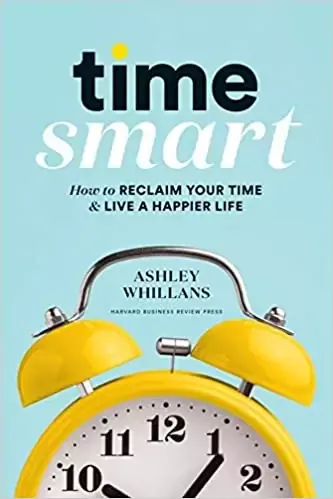
Time Smart: How to Reclaim Your Time and Live a Happier Life by Ashley Whillans
The next book is Time Smart by Ashley Williams. This book is really good if you feel like you keep on making decisions related to maybe work and taking on responsibilities that just don't seem to lead to your happiness it could also be a good book for people who are making big life decisions, people who are graduating it is a book all about how people who value their time over their money are consistently happier.
You will probably enjoy this book I will say it's more of a light read I got through it really quickly and it was more inspiring but I still found it really impactful my partner recently graduated with his master of physiotherapy and he's been on the job hunt he's now got a job but throughout the job hunt I was thinking back to this book as I was talking to him as we were discussing his options I referenced this book multiple times so if that's where you're at in life I think it would be helpful for you.
4. Metaphors We Live By
Speaking of metaphors, we first think of literature, but this book points out that metaphors are by no means exclusive to literature. From the everyday language we are accustomed to, to serious public political discourse, to mathematics and science that are considered to be the most objective and accurate, metaphors are inseparable. Twenty years after this book was published, the neurological basis of metaphor was found in the human brain.
The foundation of metaphor is based on human body experience (for example, the metaphor of "it is better" is based on upright walking) and life experience (for example, love is travel), which is generated in the interaction between humans and the environment.
Here, we see the "projection" of psychoanalysis, the shadow of Gestalt psychology, and Piaget's epistemology of generation. The cognition of the environment is engraved with the imprint of man, and man "subjectifies" the natural environment and draws a boundary for it ( If the forest is a container, it means there is a limit), and then quantifies and describes it.
This has undoubtedly subverted our traditional view of language. When we want to know the meaning of a word, we lose the first reaction to look up the dictionary, but the author slams the dictionary's view of "homonyms". Metaphor has not become a "dead" word, not an objective, abstract, isolated, closed category and definition, but it is the sculptures that highlight and hide phenomena that constantly generate new meanings in the interaction with people in specific contexts.
A metaphor is not a reflection of objective things but highlights one aspect of things and hides the other. Metaphors cannot construct an objective truth. Many words that seem to be true are actually metaphors with ulterior motives, behind which is the support of power to highlight and hide certain aspects.
The competition and change of culture are actually the competition and change of metaphors, which are the most hidden battlefields of ideology in the era of globalization. The Western metaphor of "money" (quantifiable, investment, budget, etc.) successfully unifies the global view of time. Metaphor is the intermediary between power and truth, dissolving and reconstructing culture and thinking.
The author's writing finally points to the myth of objectivism prevailing in analytic philosophy and the myth of subjectivism prevailing in continental philosophy (that is, the belief that metaphor is purely subjective and without laws). environment, and from this metaphorical language view, a different kind of "empiricism" can be deduced. The truth of empiricism is not independent of people but depends on people's understanding. Truth can be said to be a kind of understanding of the function of situations.
There are also many metaphorical examples in this book. It is not difficult to understand roughly, but the difficulty is how to apply this theory to the way we view the world, which is very challenging and very interesting.
5. Elastic Habits
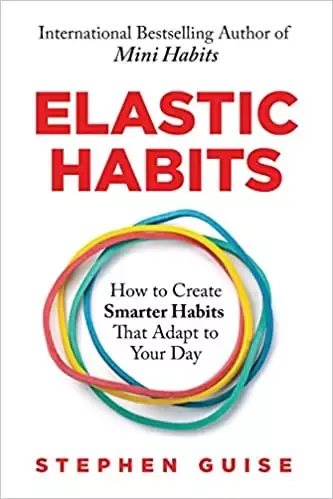
Elastic Habits: How to Create Smarter Habits That Adapt to Your Day by Stephen Guise
Doing the same thing every day is tedious and unsustainable, and doing it differently is the proper solution. The principle is the well-known saying "all roads lead to Rome"; as long as the result is clear, there are countless paths to the result, which is the origin of the "Elastic Habits".
The most impressive sentence in the book is: "Only self-discipline can be free." Self-discipline here doesn't mean running yourself on a schedule or schedule; if that's the case, you're just a slave to the schedule.
The things we do every day should be variable, and the specific number of tasks should be determined according to our state of the day.
There are 7 steps to developing a resilient habit:
- Select up to 3 Habits.
- List about 3 landscape options for each habit.
- Set up 3 portrait targets for each landscape option.
- Choose your habit cues and make a commitment.
- Show your habits.
- Track your habits.
- Score and evaluate your performance.
If you want to make persistence a priority, set your goals low enough so you never miss work. This means setting your minimum requirements to "done" rather than "show off." Just do it every day, and you'll create amazing positive momentum and rapid growth.
- Habit 1 - Exercise: Mountaineering, running, pull-ups, kicking.
- Habit 2 - Go to bed early: go to bed at 10 o'clock to read a new book, go to bed at 10 o'clock to review old books, and go to bed at 10 o'clock to write a diary.
- Habit 3 - Cut sugar: no carbohydrates a day, no beverages a day, two meals a day.
- Habit 4 - Increase income: Review the stock market, explore new opportunities, and write from the media.
6. Letters to a Young Poet
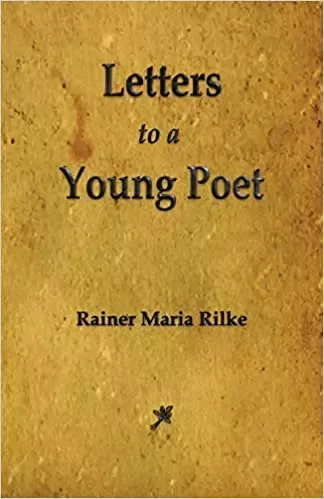
"How can we forget the myth of the primitive times of all races? The myth of the dragon becoming a princess in an emergency; maybe all the dragons in our lives are princesses, they are just waiting, beautiful and beautiful. Look at us bravely. Perhaps all terrible things are helpless in the deepest, ask us for help."
I often think of this sentence; in fact, before I have the opportunity to encounter truly terrible things, I dare not imagine putting the difficulty in any transaction to dissolve it.
Learn every day, learn from the pain I am thankful for: Patience is everything!" Pain is like a new tenant, coming and going without leaving a trace, but you know the changes. No need to hurry or use other fancy things to drive away your visitors, But in such silence and loneliness, "I don't count, but mature like trees. "Because our so-called destiny is to come out of us and not to come in toward us from the outside."
Although it seems that everyone is looking out, wanting to go out and change to a bigger one, thinking that they can meet their own destiny in a certain place, "There is no such thing as hardship or loneliness, only concealment, and deception."
But Rilke's little readers don't believe in transactions and calculations, and they don't overly envy ease and beauty. "Because there is no victory to speak of, holding on means everything."
7. A Lover’s Discourse
What is "falling in love"? We said, "Look, these two people are in love." Are we saying that these two people are talking about "love"?
If the word "love" is written in regular characters (traditional characters), it is "love". Whether it is the word "love" or the word "love", there is a "heart". "Attachment" and "adoration" are both mental activities—how can a mental activity be described by a verb with a "word beside the word"?
I don't know how many couples are secretly committed after a conversation between the two. In other words, if two people really "talk" and then "fall in love", then what is it because he/she is attracted by the other party's conversation? look? action? Speaking rate? Or a magnetic sound?
Or, these are actually just the lovers' fantasies. Once the lover finally realizes that what he/she is obsessed with has nothing to do with that person at all, the other party's "talking" is no longer "love", and then spits it out of his mouth. No longer a lotus, but a toad. Terrible image reversal - The fear of image destruction far outweighs the anxiety caused by the possible loss of love.
Roland Barthes' "A Lover's Discourse", although it is called "Whisper", in fact, the real "language" occupies very little in the book, because "love" cannot be "talked". Therefore, the most subtle thing about the book is not the "language" between lovers, but the delicate deconstruction of the lover's every moment's thoughts, and the nakedness of the lover's cuteness (stupid or absurd?).
In other words, with a copy of "A Lover's Discourse", you can throw away all the romance novels on your bookshelf.
My favorite part from "A Lover's Discourse":
"The Merry Celebrity and the Whore"
A celebrity has a crush on a prostitute, and she says to him,
"As long as you sit under my window in my garden and wait for me for a while. After a hundred overnights, I belong to you."
On the ninety-ninth night, the Yake stood up and walked away with a stool.
8. The Mastery of Love
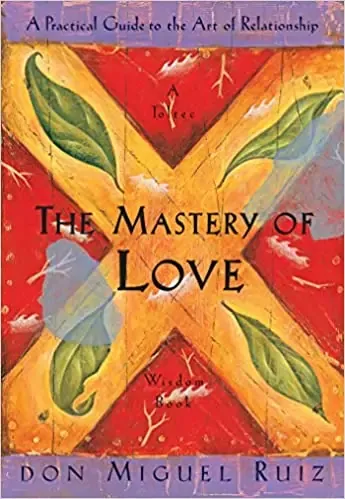
The Mastery of Love: A Practical Guide to the Art of Relationship: A Toltec Wisdom Book by Don Miguel Ruiz
Imagine we are born in a world where, as the author assumes in the book, everyone has a congenital skin disease at a certain age. When humans are infants, they do not feel the difference in their bodies, but as they grow up, the disease shows. Our skin feels hurt every time we are touched by others.
Every doctor says it is normal because everyone is the same, so everybody lives this way. Parents keep telling the next generation that it hurts and influences them on their own.
Actually, the disease means our wounds inside, which do not show when we were children. With time passing by, we have fear, we have opinions of others, we are eager for love, and we beg for acceptance, which is the process by which the wounds appear and the customs form. To show originality, Miguel Ruiz explains how love operates and how we overcome its difficulties.
I feel quite impressed and touched. What is the definition of love?
None of us dares to clarify, and even Miguel Ruiz himself can only show us the iceberg. For the first time, however, I was told that my pain was real and accepted through the book. We tend to avoid possible hurt, so we are careful in relationships.
We tend to be afraid of being hurt again because of our stereotype of wounds, so we keep pushing or hurting people in our own way. What if we can face our wounds of how they were caused and how we carried them in our hearts?
Is there any possibility that we can heal our wounds inside and feel no more hurt, that we can try hard and chase braver the time we are faced with another opportunity of a job, a dream, and even a person, that we can live peacefully and happily for the forgiveness of regrets, that we can educate our next generation better and treat the old kinder?
For my part, I can say that I have finally found my love settled and my pain in peace, for I know that true love comes inside independently and shows outside purely and confidently.
9. Bulfinch's Mythology
The story of this book is full of details and twists. Unlike Chekhov's principle of "if a pistol appears in a story, it will be fired", there is no way to predict the role and relationship of the characters appearing. This makes the legend almost like the truth.
The story of Tristram and Isolde is just that, under the theme of traditional love tragedies beyond love, with a lot of unrelated details. These details acquire symbolism due to their irrelevance to the subject. That is to say, their meaning is not in the text but is hidden in a deeper place and is only suggested by some symbols.
Music plays an important role in the story; Tristram uses music to get back Isoude, the damsel wakes up Tristram with music, the king gives Isoude to Palamedes because of his curiosity about music, and so on. The animals also made some impressive appearances, such as Tristram's dog Houdini, who was given away twice, both as souvenirs, and drank the love magic water with Tristram and Isolde.
His IQ makes it possible for him to feel the potency of the magic water as much as a human being. After all, to keep Tristram from being discovered, he doesn't bark while hunting!
After reading such a messy but full of vitality story, and then reading ordinary novels, the difference is huge. Ordinary novels are very clean, as if the branches have been cut off, with clear meaning and consistent temperament. However, assigning meaning to legends is difficult, and the various symbols of unknown meaning are fascinating.
What does this story show? What kind of spiritual journey does a knight/musician with a complex character like Tristram represent? What does Houdini stand for? Why did Tristram marry Isoude, who had the same name as his sweetheart? The story celebrates honor but also less honorable love.
10. The Fabric of the Cosmos
The Fabric of the Cosmos: Space, Time, and the Texture of Reality by Brian Greene
The past, present, and future in our minds are illusions that are too difficult to overcome.
Einstein once said,
“For we convinced physicists, the distinction between past, present, and future is only an illusion, however persistent.”
After reading Chapter 5, I have already lamented many times that I was fortunate enough to experience such brain activity. Not a waste of life. He also said with emotion that I am forever grateful for the day when Brian Greene was born. But of course, I should feel grateful for the day when Einstein was born.
As a side note, the chapter on quantum entanglement (Chapter 4) is also enlightening, mesmerizing, and powerfully touching. When Einstein is proved wrong, it's time to allow some space for the wonders in our mystical universe.
I don't know how Brian Greene can explain it so patiently and lovingly that no other physics popular science book can. For example, the book The Order of Time only mentioned that time on distant planets was meaningless but failed to explain in detail what the problem was.
Greene finally answered my question in Chapter 5. Creatures of distant planets can travel a hundred years in our time in a few steps, and we also travel a hundred years in others in a few steps.
“In this way of thinking, events, regardless of when they happen from any particular perspective, just are. They all exist. They eternally occupy their particular point in spacetime.
There is no flow. If you were having a great time at the stroke of midnight on New Year's Eve, 1999, you still are, since that is just one immutable location in spacetime.
It is tough to accept this description since our worldview so forcefully distinguishes between the past, present, and future. But if we stare intently at this familiar temporal scheme and confront it with the cold, hard facts of modern physics, its only place of refuge seems to lie within the human mind.”
Time does not flow; it is always fixed at a certain point in time and space. If you are happy at a certain moment, you are still happy because that point in time and space is fixed there and will not change.
11. From Dawn to Decadence
From Dawn to Decadence: 1500 to the Present: 500 Years of Western Cultural Life by Jacques Barzun
I was wandering in front of the history bookshelves in a bookstore and stumbled across a great book that I almost missed.
The book is called From Dawn to Decadence: From Dawn to Decadence by Jacques Barzun, who won the 2000 National Book Award. Just reading its preface, I was fascinated by it.
The book first quotes a passage from William James:
All human actions can be attributed to the creation of inventors big and small and the imitation of others. Individuals point the way, determine patterns. The competition between modes is the history of the world.
This sentence got me thinking. The mode is a typical Western way of thinking.
Jacques Barzun said:
Newspapers love to use the phrase "the trash can of history". Inspect this trash can and see that it is far less full than one might think. Repeats and restorations have been common over the past five centuries.
For example, just look at the incoming intellectual interest in biblical texts and the life of Jesus to talk about dream problems.
Or imagine another thing that can be thrown in the trash and ignored: a newspaper's horoscope column. The competition between modes rarely ends in a complete victory; the loser survives and fights, and the opposition is always there.
This sentence makes people smile, not only in the West but also in the East. From the May 4th Movement to the Cultural Revolution, Kong’s family shop was swept into the “garbage heap of history”.
It takes a lot of effort to read a big book. This book is 824 pages long, and I plan to read it in two weeks. If you come across a moving passage, please share it with me on the blog.
12. The Master Switch
The Master Switch: The Rise and Fall of Information Empires by Tim Wu
It turns out that the development of the communication media industry in the United States is also regulated by the government. And it's not free competition; it's monopoly capitalism.
Kronos Effect: the efforts undertaken by a dominant company to consume its potential successors in their infancy. Traditional industries will always try to stop the progress of new industries. It is outsiders who bring about subversive reforms.
The relationship between monopoly and competition, as mentioned in the text, must be divided for a long time, and a long time of separation must be combined. The view that we accept now is that a monopoly is bad, but is a monopoly really bad?
On the contrary, a monopoly can bring efficiencies, such as AT&T, when a monopoly can bring lower tariffs and better services, but after being split, tariffs suddenly rise, and communication quality is also low.
However, the monopoly affecting innovation is the biggest disadvantage. He will try to hinder all new inventions that may affect his status, just like Bell Labs, and will also stretch his hands upstream and downstream to form vertical integration.
The meaning of the master switch: The article analyzes four industries: the communication industry, the cable TV industry, the film and television industry, and the Internet industry. These four industries are all information industries, capable of controlling people's actions and thoughts, thereby changing the appearance of a country.
The giant AT&T in the communications industry has risen twice and is very resourceful. The first time was to form a cooperation with the government. Indeed, the government is more willing to cooperate with as few participants as possible in the industry, which is more efficient.
But he suppressed other possibilities for competition, and he faced pushback from the Antitrust Bureau and the Justice Department.
The second rise is to take advantage of the law, maintain competition in name, and welcome other competitors to join his line. In essence, the bottom line is drawn from the bottom line, leaving competitors complaining and returning in disappointment.
The wireless broadcasting industry has contributed to the slow and hampered development of cable television in the United States.
13. The Righteous Mind
The Righteous Mind: Why Good People Are Divided by Politics and Religion by Jonathan Haidt
The Righteous Heart is a very persuasive book. It is so persuasive not because the author has constructed an extremely precise and impeccable theoretical system in the book, but because the author is well versed in the intuitionistic way of persuasion, that is, if you want to change a person's perception of a certain The opinion of something must speak to his intuition.
So instead of getting straight to the point and addressing his core findings at the outset, the author takes a detour and tells the history of moral psychology and his personal story, creating a sense of transition from rationalism to intuitionism, Let the reader's elephant (intuition) gradually deflect the direction in such a feeling and atmosphere.
The most impressive theory in the book is the theory of moral foundations. Unlike many moral philosophers in the past, the author's moral theory does not center on a single supreme principle but is built on multiple foundations. Heit believes that morality can never be discussed without the theory of evolution.
There are some basic social senses in various human groups and different cultures, which are as common as the human sense of taste. threats or opportunities. There is more than one threat and opportunity, so there is more than one moral foundation developed based on it, just as the human sense of taste is divided into sour, sweet, salty, bitter, and spicy.
Hite's six foundations are first derived from keen observation and profound insights and then supported by rigorous psychological experimental methods and data. Doki's morality provides a good perspective for our understanding of the diversity and differences in morality and some of the moral dilemmas facing human beings.
In his book, Haight succinctly and brilliantly lays out the respective contexts of liberalism and conservatism with his theory of moral foundations.
Of course, differences in the moral senses are not purely innate, i.e., not entirely due to evolution. Haight agrees with neuroscientist Marcus that evolution (genes) provided the first draft of the moral picture of man and that picture is continually being painted throughout a person's life.
This is where people's inconsistent moral preferences in different cultures arise, and the well-known East-West difference is one such example. Even in the same cultural environment, the differences in individual emotional and spiritual experiences make people's moral landscapes very different. Morality can be shaped by nurture, which is the reason all moral education exists.
As stated at the beginning of this article, the author advocates a more intuitive approach to morality and moral education, one that takes a more humble view of individual abilities and places a greater emphasis on the environment and the environment that makes people think and do better. social system. This point of view is undoubtedly instructive for our moral education.
14. Games People Play
Games People Play: The Basic Handbook of Transactional Analysis by Eric Berne
The author's research orientation is interested in how early life affects people; the results of the research can help people gain insight into the underlying rules and patterns behind the seemingly chaotic human interactions.
- The reward of the game strengthens the basic "positioning" of a person's existence in the world. The fundamental stance that TAs take towards themselves and others also reinforces the player's scripted decisions; scripts are made up of repeated games and their rewards.
- To survive psychologically, people must be appeased. However, because the internal rules of society and individuals restrict people from freely exchanging appeasement, people generally lack appeasement. Games thus become adults' power struggles for pacification.
- To be appeased reasonably, pay attention to the psychological status of "Hello, I am good" and the autonomy shown by awareness, spontaneity, and intimacy, and help people get rid of games and destructive scripts.
The rules and steps of the game can help people understand their own behavior, and resetting these steps and rules can help us improve the way of behavior better and more actively - reset the rules and steps of the game (script).
Therefore, people should realize that their behaviors are understandable and that these behaviors can be changed.
15. Sex at Dawn
Sex at Dawn: How We Mate, Why We Stray, and What It Means for Modern Relationships by Christopher Ryan
Before reading this book, I had never questioned the obviousness of early human monogamy (and occasionally polygamy). Not only are the hypothetical pictures of primitive humans everywhere depicted in this way, but the current social reality also supports such a possibility.
However, according to the author of this book, this is also an invisible "Flintsonation", that is, to understand historical events with modern thinking frameworks and concepts, such as looking at slavery from a current perspective or using the sexuality of current human beings' Behavioral observations to understand primitive human sexuality.
The point of view of the two authors of this book is that, regardless of some close relatives of human beings (Pan genus, two chimpanzee bonobo and chimpanzee), some physiological structures and sexual behavior characteristics of human beings are still few visible in the anthropology of primitive tribes.
From the observation point of view, early human beings should be neither monogamous nor polygamous, but in a many-to-many (promiscuous) "social" sexual relationship. The reason why we say social type is that in addition to being a necessity for reproduction, sexuality itself also enhances social relationships.
The reason why human beings have become the structure they are now is entirely due to a great "fall", that is, the emergence of agriculture. The advent of agriculture dismantled the mobile hunter-gatherer lifestyle of early humans. The status of men in social production has improved (they need to engage in a lot of farming work), and women need to rely on men for support.
Since then, not only has the power structure of society changed, but so has human sexuality. The allegory of the Garden of Eden is exactly the portrayal of mankind's "fall" from a primitive hunting-gathering society to an agricultural society, and this time, the "fallen" mankind has not yet "recovered".
The layman doesn't take a particular view of the debate on sexuality but finds the latter aspect of the interplay between social structure and sexuality interesting. However, the author spends most of his efforts refuting various existing ideas about early human life and sexuality and does not delve further into it. In fact, the main idea is explained in the first few chapters.
Finally, I remembered that there was a mention in the book that, counting gorillas and chimpanzees and humans, only females of bonobos and humans are sexually active throughout the cycle, while common chimpanzees and other gorilla females are only in Being sexually active during ovulation (and thus also leading to stronger sexual selection).
In this regard, the author said that the traditional church view of "it's not right to be in heat all day like an animal, and people want to have abstinent sexual behavior for reproduction" is just the opposite. "Temperance" sexual behavior, and "in the heat all day long" is precisely the characteristic of human beings
In this book, Russell discusses various common problems, such as the struggle for existence, boredom, jealousy, fatigue, etc., and elaborates on the ways he thinks they can be avoided.
Russell does not follow any profound theory but summarizes some reasonable opinions confirmed by his own experience and observation and makes a prescription for readers, hoping that countless men and women who feel depressed can find their medical records and escape methods here and can become happy with appropriate efforts.
The book is easy to understand and has always been loved by readers, and several translations have been published in China. Mr. Fu Lei's superb translation adds luster to this book.
Neuroscientist Daniel Bohr believes that consciousness is a product of the brain and that it develops as knowledge accumulates.
Consciousness is actually a thought factory, a carefully selected mental space dedicated to innovation. The main task of consciousness is to discover deep structures.
Bohr's mode of operation of consciousness explains why our brains voraciously seek out information, especially those with patterns. For example, we play crosswords and Sudoku when our biological needs are met.
From a biological point of view, playing these games is a waste of time, but in Bohr's view, this structure-seeking behavior has great evolutionary significance. It is this search for structural patterns that led humans to discover fire and learn to farm.
"The Theory Of Everything: Origin and Destination" are seven lectures given by Stephen Hawking at the University of Cambridge, UK. Even those with a little basic scientific knowledge can get a glimpse of the wonder and magnificence of the creation of the universe after reading these seven lectures.
These speeches not only shine with Hawking's aura of wisdom but also reflect his unique wit. When talking about the black hole research that took him more than ten years, he said: "It seems a bit like looking for a black cat in a coal cellar."
Hawking talked about the history of human understanding of the universe, and Aristotle confirmed that the Earth is a sphere. It took more than two thousand years until Hubble discovered that the universe was expanding.
Using this as a starting point, he explored many areas of modern physics, including theories of the origin of the universe (i.e., the Big Bang), the properties of black holes, and space-time.
In this book, Huo Hui takes readers on a riveting, exploratory journey through the universe and our place in it.
The book Wayfinding China has several different threads. It first narrates the author’s journey of thousands of miles across northern China from the coast of the East China Sea along the Great Wall to the west, Scenes from urban life in an industrial town.
The development described in the book, from agriculture to industry to commerce, and from the countryside to the city, is the most important change that has taken place in China since the reforms in 1978.
"Looking for China" is the finale of the Chinese Documentary Trilogy. It explores the economy, traces the sources of development, and explores individual responses to change.
It studies the core issues in China, but it does not achieve this goal by interpreting famous political or cultural figures, nor does it make macro and unreasonable analyses.
It only shows the essence of China's transformation by describing the experiences of ordinary Chinese people.
"Visual Hammer" is the inheritance and development of the "Positioning" theory. "Positioning" is to find a vacancy in the consumer's mind and then implant a nail.
In the visual age, the best way to seize consumers' minds is not only to use "language nails", but also to use a powerful "visual hammer".
Visual images are like hammers, which can establish positioning faster and more powerfully and resonate with customers.
The author pointed out that the relationship between visual image and language information is like a hammer and a nail: use the hammer of the visual image to implant your language nails into the minds of consumers.
In Laura Reese's book, we talk about two reasons why we need "visual hammers": to recognize faster, they can be recognized almost immediately. Only by making good use of the "visual hammer" can communication efficiency be maximized.
21. Made to Stick by Chip Heath, and Dan Heath
You may believe that the only man-made structure you can see from space is the Great Wall. Coca-Cola can corrode human bones and use up 10% of our brains. At the same time, you can’t remember the arrangement of the leaders at the regular meeting last week. You saw it yesterday.
What was written in the book, the main content of the last training...why?
This leads to the core question of "Making Ideas Stickier": What kind of ideas have strong stickiness and can be firmly remembered by others? Internationally renowned behavioral psychologists Heath Brothers, based on a large number of social psychology research cases, revealed six paths that make ideas sticky: simple, unexpected, concrete, credible, emotional, and story.
"Making Creativity Sticky" has been popular in many countries since its publication, and it has topped the Amazon bestseller list for 6 years and is a classic bestseller in the New York Times.
Whether it's a company executive who needs to convince his subordinates, a salesperson who needs to impress a client, or an advertising person who needs to create ideas that reach people's hearts, people from all walks of life can find the stickiest way to express their ideas or opinions.
22. Hooked by Nir Eyal and Ryan Hoover
"Hooked" reveals the basic design principles behind many Internet products and services that allow users to form usage habits and even "addiction," and tells you how to create a product that users can't stop using.
Based on his many years of research, consulting, and practical experience, the author puts forward a novel and practical "Hook Model" (Hook Model), which is designed to develop users' usage habits through four aspects.
Through the continuous "addiction cycle", let users become "repeat customers" and then achieve the ultimate goal of circular consumption instead of relying on high advertising investment or excessive and rude information dissemination.
This book is specially created for product managers, designers, marketing and sales personnel, and advertising creators. Everyone who deals with user behavior deserves to be regarded as a must-have guide for their desks.
For readers who want to understand the science of behavioral design, this book will also give you a deeper understanding of yourself and the current hot products.
Every year, Buffett writes a letter to shareholders in Berkshire Hathaway's annual report, summarizing the successes and failures of the past year. These letters cover everything from picking managers, choosing investment targets, and evaluating companies to using financial information effectively.
However, the ideas contained in these letters did not receive the widespread attention they should have received until Lawrence S. Cunningham, an American law professor, organized the specific themes of these letters in this book.
Buffett himself thinks this book is better than any biography about him so far, and if he had to pick one book to read, it would have to be this one.
Buffett is the first rich man in the world who has assets of tens of billions of dollars through securities investment. In the past 35 years, the book value per share of Berkshire under his leadership has risen from $19 to $37,987, with a compound annual growth rate of 24.00%.
What is particularly commendable is that Berkshire is already a giant enterprise with total assets of more than 130 billion US dollars. No one's success is accidental.
After reading this book, readers must have an in-depth and comprehensive understanding of Buffett's investment philosophy, and it is not difficult to imagine why he achieved such an amazing performance.
24. Tipping Point by Malcolm Gladwell and Hachette
"The Tipping Point" is a brilliant work by "New Yorker" geek Gladwell. Taking the sudden popular trend in society as an entry point, he explored the control science and marketing model from a new perspective.
He believes that ideas, behaviors, information, and products often spread like infectious disease outbreaks. Just as one sick person can cause a city-wide flu outbreak, a few graffiti lovers can start a crime wave in the subway, or a satisfied customer can fill a new restaurant to open.
These phenomena are all "social epidemics", and the moment they reach a critical level and erupt is a "tipping point".
Gladwell interviewed religious groups, successful high-tech companies, and the world's best salesman. , smoking, children's TV programs, commercials, etc., and clarify the fuse behind it, revealing the principles and methods that trigger the epidemic and maintain the momentum.
This tipping point is what makes you a great parent, marketing manager, policy maker, and businessperson!
The pyramid principle is a kind of logical thinking, expression, and normative action with a prominent focus, clear logic, and clear primary and secondary.
The basic structure of the pyramid: the central idea is clear, the conclusion comes first, and the above is unified, classified into groups, and logically progressive. First, the important and then the secondary, first the overall situation and then the details, first the conclusion and then the reason, and the result and then the process.
Pyramid trainers expressers: pay attention to and tap the audience's intentions, needs, interests, concerns, interests, and excitements; figure out what to say and how to say it; and master the standard structure and actions of expression.
The pyramid helps to achieve the purpose of communication: the focus is prominent, the thinking is clear, and the primary and secondary ideas are clearly defined so that the audience is interested, understanding, accepting, and memorable.
The specific method of building the pyramid: top-down expression, bottom-up thinking, vertical question answering/summarization, horizontal classification, grouping/deductive induction, preface to tell stories, and title to refine the essence of thought.
As good and law-abiding people, maybe we never thought of having anything to do with "violence".
However, if we pay a little attention to the way of talking in real life, and experience the different feelings that various ways of talking give us, we will definitely find that some words are indeed "violent"!
"Nonviolent Communication" believes that we may not think that the way we talk is violent, but our language often causes pain in ourselves and others.
Verbal duty, ridicule, negation, preaching, arbitrary interruption, refusal to respond, and casually exported evaluations and conclusions bring us emotional and mental trauma, which is even more painful than physical injury.
This unintentional or intentional verbal violence makes people indifferent, alienated, and hostile to each other. Indian philosopher Krishnamurti believes that observation without comment is the highest form of human intelligence.
Being effective is what managers must do in all knowledge organizations. Every knowledge worker is actually a manager, even if he has no so-called authority, as long as he can make outstanding contributions to the organization.
The effectiveness of managers is often the most critical factor in determining the effectiveness of an organization's work.
Not only are senior managers managers, but all those who are responsible for actions and decisions and help improve the effectiveness of the organization's work should work like managers and think like managers.
Familiar people around us, whether it is Peter Senge, the advocate of the fifth discipline, Philip Kotler, the father of marketing, John Kotter, the leadership guru, or Andy Grove, the president of Intel Corporation, Bill Gates, chairman of Microsoft, and Jack Welch, CEO of General Electric...
They were all inspired and influenced by Peter Drucker in terms of management thinking and management practice.
28. Fascinate by Sally Hogshead
In this turbulent, overcrowded world, how do politicians, businessmen, salesmen, friends, and family members affect you and change you?
Obsession is the most powerful way to influence decisions. It is more persuasive than marketing, advertising, or other forms of communication.
And its production stems from 7 triggers: desire, mystery, alarm, prestige, power, guilt, and trust. From the brand you choose to the song you memorize, from who you marry to the staff you hire, you seem to be "in control" of everything, but you are actually manipulated by the trigger of "obsession".
Read this book, learn to activate the right triggers, and you can make anything fascinating, including yourself.
The author looks at the whole world from a perspective beyond marketing. She goes deep into the latest research frontiers of historical cases, behavior and sociology, neurology, and human evolution to reveal why we are fascinated and obsessed with certain things. It will also let you understand how to use the irresistible influence of "obsession" for yourself.
"Infatuation" stands at the forefront of academics, and every argument is supported by research results in psychology, human evolution, neurobiology, etc., but it is never boring and blunt - "Infatuation" itself is a book that makes people extremely obsessed with books.
Compared with "Infatuation" and "Stuck", this book pays more attention to the essence behind the phenomenon from a theoretical and academic point of view, and then analyzes and explains it with examples. The first two are more methodological and start from the form.
Ideas are still available and unavailable; only by combining your own core points with these principles ingeniously can you create a phenomenon that goes viral. The STEPPS principles
In this book:
- Social Currency: People tend to choose iconic identity signals as the basis for judging identity. People like to share because they will feel that it is a reflection of their personal identity, which will make them look more shrewd and witty and get more praise. Planning a thing can reflect their identity; for example, the lever game shows that scarcity and exclusivity increase their sense of belonging.
- Trigger: To put it simply, let your product be linked to something that often appears in people's vision and constantly stimulates people's associations (increase its activation rate)
- Emotion: There are negative and positive points, and this distinction is not comprehensive, it is also necessary to evaluate whether emotions have high arousal, which can be realized in physical and psychological aspects (Americans are interested in health and education topics); alone The psychological or physiological responses that are stimulated will also affect people's enthusiasm for communication.
- Public: Make use of people's herd mentality to increase the visibility of marketing and amplify this herd. Prove that I am a part of the society (FB's guide comment); use the remaining behavior to increase visibility and publicity.
- Practical Value: What is the benefit of your thing to people, how to magnify this benefit, apply prospect theory (you need to set a reference point; the same discount value will become smaller as its base increases), Increase its limitations, 100 principles, etc.; this is mainly for the person who receives the information
- Stories: This is a bit like the one in "Stick"; is it really the relationship between the teacher and the student? However, when we make a story, we must pay attention to integrating the benefits of our products with the story.
The full title is Out of Control: The New Biology of Machines, Social Systems, and the Economic World.
"Out of Control" was written in 1994.
What this book describes is his role at the forefront of technology, society, and the economy at that time, as well as the future picture he gleaned from it.
Concepts that are mentioned in the book and are emerging or hot today include crowd wisdom, cloud computing, the Internet of Things, virtual reality, agile development, collaboration, win-win, symbiosis, co-evolution, network community, network economy, etc.
It is not an exaggeration to say that it is a "prophetic" book. There must also be hidden "prophecies" about the future that we have not confirmed or penetrated.
31. Thinking, Fast and Slow by Daniel Kahneman
This book is a reflection of thinking. System 1 makes rapid judgments by relying on emotion, memory, and experience. 2. Rational person vs. human experience self vs. memory self.
Through the study of human judgment, decision-making, and choice, Caiman discusses fast thinking and slow thinking, intuition, and rationality, as well as human defects in the process of decision-making.
Promising review:
A brilliant (indeed, Nobel Prize-winning) concept made unbearably tedious by endless case studies. Kahneman going on for over 400 pages about his two systems reminded me strongly of Bernard Shaw's comment on Darwin:—Read More—WSG01
Click Here To Check Out More of Author Daniel Kahneman's Books on Amazon.
32. Sapiens by Yuval Noah Harari
Sapiens helps you understand how humans rose from ordinary apes to dominate the Earth by showing how belief, cooperation, and shared stories gave us power over nature and each other.
- Feeling overwhelmed by the massive history of humankind? I sure was. But this book breaks it down without making your head spin. You’ll see how tiny changes—like language—snowballed into stuff like cities, religion, and taxes.
- Harari doesn’t just give facts—he asks questions that get under your skin. Like, why do we believe in money or countries? Ever wonder why humans farmed when hunting was easier? Me too.
- It’s not just “what happened,” but “why did we think that was a good idea?” That shift in thinking? It messed with my head—in a good way.
- The book shows how shared beliefs (even made-up ones) shaped human life. It makes you ask: What beliefs are shaping mine today?
- Best part? It treats your brain with respect—doesn’t dumb things down, but doesn’t throw weird science words at you either. It helped me gain knowledge about who we are and why we act so weird sometimes.
33. A Brief History of Time by Stephen Hawking
Hawking's book explains the structure of the universe, black holes, and time itself in ways that turn impossible-sounding science into something you can understand.
- Confused by stuff like black holes, time travel, and “the beginning of everything”? You’re not alone—I had no idea what I was in for. But Hawking speaks like a cool science teacher who’s more interested in blowing your mind than making you memorize formulas.
- He breaks down tricky ideas using simple examples. Like, I still think about his bit on how time might behave like space—what?! That thought stuck with me for weeks.
- If you’ve ever stared at the stars and felt small (or kinda amazed), this book helps you turn those feelings into actual knowledge. And honestly, that helped me feel more connected to the world.
- Hawking never talks down to you. He respects your brain, even if you’re not a physics nerd. His style permitted me not to “get” everything at once.
- The book made me feel smarter without making me sweat. That’s rare. I went in knowing nothing about theoretical physics and came out saying, “Wait… could time bend?”
34. Guns, Germs, and Steel by Jared Diamond
This book explains why some societies advanced faster than others, based not on brains or effort, but geography, food, and germs that gave them a head start.
- Ever wonder why Europe got “rich” and other parts of the world didn’t? I used to think it was just luck or invention. Turns out, there’s way more to it—and Diamond spells it out without getting preachy.
- He shows how geography gave some people crops, animals, and disease resistance, and how that shaped the power structure of the entire world. It seriously changed how I saw history.
- The book doesn’t just throw data at you—it builds a story. Like, I remember being shocked that farming wasn’t a big leap forward for everyone. For some, it made life harder.
- It helped me stop blaming individuals for huge historical events. Instead, I saw how environments shaped the tools and choices people had. It’s not about who’s smarter—it’s about what tools you had to work with.
- Yeah, it’s heavy stuff. But it’s also one of those books that makes you sit up and go, “Ohh… now I get why things are the way they are.” If you want to gain wisdom that’ll shift how you view the world, this one does it.
Conclusion
Books are more than just stories or facts—they’re tools to help you think smarter, make better decisions, and understand the world and people around you more deeply.
Whether you dive into non-fiction for practical knowledge or explore fiction and poetry to sharpen your insight into human nature, every page you read trains your brain a little more.
The journey to becoming smarter doesn’t have to be overwhelming—it’s about consistent, curious reading that challenges your mind in different ways.
So start today, pick up a book that excites you, and watch how your thinking transforms one chapter at a time. Smarter, clearer, wiser—you’ve got this.
🌱 This post is part of our Personal Growth Hub — featuring the best books on productivity, mindset, emotional intelligence, resilience, and success.
📚 Explore All Hubs